Home » Researcher in Residence Sprint: Everything you need to know
Researcher in Residence Sprint: Everything you need to know
**THE CALL FOR THE RIR SPRINT IS NOW CLOSED. NO FURTHER APPLICATIONS FROM THIS DATE (1st SEPTEMBER 2026) WILL BE CONSIDERED. THANK YOU. **
The Innovation Launchpad Network+ (ILN+), has secured an additional £500,000 from the Engineering and Physical Sciences Research Council (EPSRC) to launch the Researchers in Residence (RiR) Sprint Programme.
Running between October 2026 and February 2027, the RiR Sprint will build on the success of the Network’s flagship Researchers in Residence scheme by providing a new fast paced model of collaboration between universities and the Innovate UK Catapult Network.
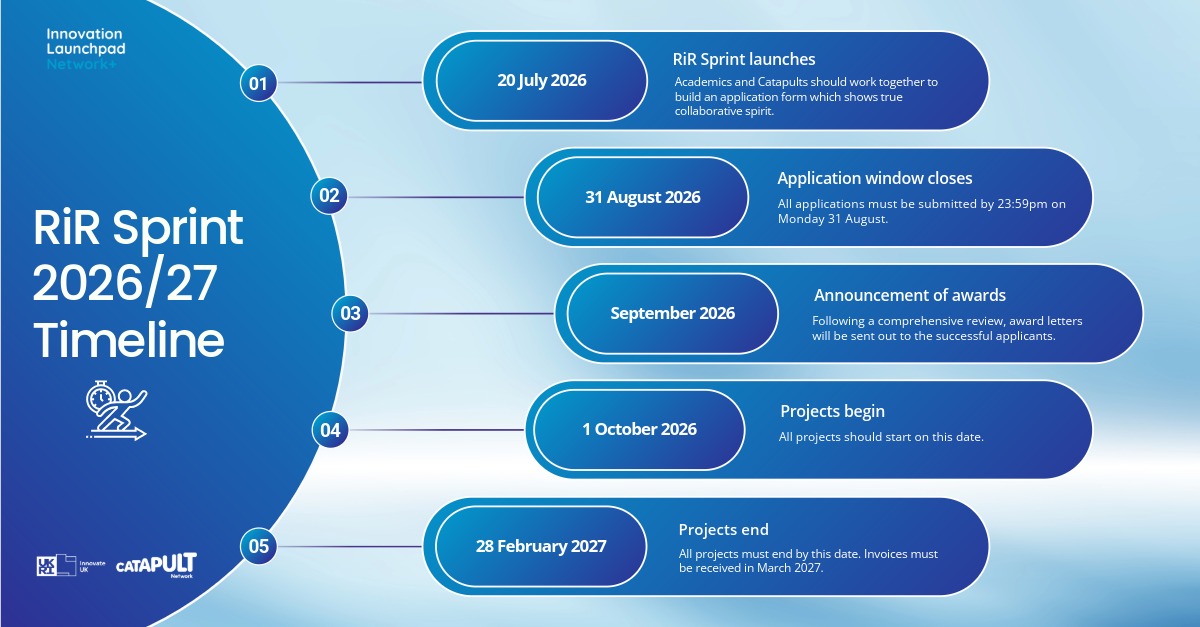
The call for the Researchers in Residence Sprint programme is open now, with projects commencing in October 2026 and ending in February 2027. Applications are invited for projects of up to £50,000 in university researcher costs, supporting fundamental research to move beyond the university lab and towards real-world application.
Below is our three step guide to joining the Researcher in Residence Sprint programme.
Step 1
Contact your proposed host Catapult to discuss your project idea. A list of Catapults and their contact details are available on this page. You MUST have a discussion with a Catapult contact prior to submitting an application. The Terms and Conditions of the RiR Sprint programme can be viewed on this page.
Please note, some Catapults have restrictions on nationalities that they can collaborate with, so make sure you are eligible to work with them and get a template of their Collaboration Agreement to your institution’s legal team for review as soon as possible.

↓
Step 2
Request an application form from the Innovation Launchpad Network+ management team at rirapplications@amrc.co.uk. Tell us a little bit about your project idea, state which Catapult you have discussed it with and we’ll send you an application form.

↓
Step 3
Co-develop your application with your host Catapult, get your Letter of Support from your institution and submit both to rirapplications@amrc.co.uk by 23:59 (UTC+1) on 31 August 2026.

What happens then?
Applications will be assessed by at least two independent reviewers against the following criteria:
- Research quality (novelty of the research, relevance to the Innovate UK Catapult Network and UK businesses)
- The candidate’s track record in this area and ambition
- Alignment of the proposal to the scheme’s themes, the applicant’s plan for translation and significance of the impact
- Justification of resources, planning and management
In addition, consideration will be given to the capacity of the Catapult(s) to support the project within the proposed time frame. Where specific Catapults are over subscribed, applications will be prioritised.
Shortlisted proposals will go on to a panel of representatives from the Innovate UK Catapult Network, EPSRC and the Network+, who will confirm the final list of projects that will be funded.
The evidence of review, marking scheme and the confidentiality of the process will mirror the EPSRC’s existing peer review practices, while being coordinated by the Network+. Applicants will have the opportunity to respond to reviews.
Award letters will be sent to successful applicants in September. Awardees will need a Collaboration Agreement between their institution and their host Catapult before starting the project in October. The host Catapult will provide their template at the start of project discussions.
An induction to the RiR programme will be followed by publication of the selected projects on the Innovation Launchpad Network+ website.
Guidance for applicants
Projects have a fixed start on 01 October 2026 and must be fully completed by 28th February 2027. There is no flexibility or opportunity for extension. Please do not apply if you cannot commit to these dates.
The applicant should be the person undertaking the Researcher in Residence placement. We’re not looking for an extensive track record of funding, first time applicants with great ideas and relevant experience are welcomed.
Applicants are expected to hold a PhD (or demonstrate experience and knowledge to a similar degree) and be employed in full or part at a UK university for the duration of the placement.
Proposals must be supported by at least one of the Catapults (see catapult.org.uk/about-us/our-centres for details), which will host the applicant and provide access to state-of-the art equipment and resources in line with the jointly agreed scope of the research. Applications will not be accepted if the proposal has not been co-developed with the host Catapult.
Your answers must be clear, concise and free of technical jargon. Think carefully about:
Fit with the Network’s strategic priorities (Net Zero, Healthcare and Wellbeing, and Resilience) – Justify why this proposal warrants support by the UK taxpayer. Describe how the potential benefits align with national priorities, how the research relates to the EPSRC’s research areas and strategies, and how it complements other research activity in the field, especially within the Catapult context.
Deliverables – Outline up to five deliverables against which the success of your project can be measured.
Impact – Describe the envisaged impact on the UK economy and society. Explain how the project will engage users and beneficiaries to increase the likelihood of impacts outside academia.
Project costs
The maximum award value is £50,000. Funding will be awarded directly to the RiR’s university. The award can be used to cover 100% of directly incurred staff costs (salary, pension, employer’s NI, app levy) and directly incurred other costs (e.g. travel, consumables, software licenses). Overhead costs (directly allocated staff, estates, technicians and indirect costs) are not eligible.
Letters of support
A Letter of Support from your home university must be submitted along with your application. This letter should include:
- Confirmation that the signatory has read and understood the terms and conditions of the award and the collaboration agreement template.
- Confirmation of the institution’s support for the researcher doing the placement.
- A statement about how it helps the institution to achieve their strategic objectives.
- A breakdown of the costs as stated in the application form and confirmation that they have been calculated in accordance with usual costing procedures.
The signatory should have sufficient authority to confirm that the applicant can spend their time on the placement.
Equality, Diversity and Inclusion
A great idea can come from anyone. The Innovation Launchpad Network+ recognises that the provision of equal opportunity, valuing diversity and promoting a culture of inclusion is vital to our success. While the diversity of applicants and awardees to UKRI calls is on an upward trend there is more work to be done to ensure that both reflect the wider makeup of the population. The Innovation Launchpad Network+ has via its activities the opportunity to improve the situation and promote development of improved Equality, Diversity and Inclusion (ED&I) practices across the sector.
Like many UKRI-funded activities, the ILN+ collects ED&I data for our applicants and awardees. After submission of your application, we will encourage you to complete our ED&I monitoring form to help us understand diversity and promote inclusivity in our Researchers in Residence community. The raw data is kept separately from your application, is accessible only to Network+ Management and only used for monitoring purposes. Summarised data will be shared with EPSRC.
Contact us
For general enquiries, please contact the Innovation Launchpad Network+ management team at rirapplications@amrc.co.uk.
Innovation Launchpad Network+ Management Team at the University of Sheffield Advanced Manufacturing Research Centre:
- Director: Prof Pete Osborne
- Network Manager: Dr Kristina Parry
- Network Officer: Dr Carlos Brambila
- Communications and Events Officer: Paul Stimpson
Need some inspiration? Take a look at the Researcher in Residence Case Study Hub for full-length Researcher in Residence projects.